Posts

"The Bible Says", and Other Terrible Sayings

Often, in the Protestant milieu, one hears such things as, "The Bible says ... ", followed by their pet heresy or denial of the Truth. This is patent silliness.  The Bible doesn't "say" anything.  It just sits there on the desk.  Opened or closed?  Doesn't matter, although in many cases it is closed anyway! The Bible does not speak, but the reader. The Bible itself (I mean the book with pages that sits on your desk) is but impressions of ink on paper. It is the reader that speaks, or the one who gives the interpretation also, not the Bible itself. One might object, of course, to my blatant pedantry.  Why am I being so silly? When colloquial understanding is in accord with Truth, one need not dig deeper and examine the usage.  But when it is turned against the Truth, as this kind of statement often is, precision of language is paramount. Here's why it's a big deal. I saw this sentiment asserted recently in this form: We, as Christian...
On the Traditionalist/Perennialist School

At one point, I studied, absorbed, and even kind of believed the teachings of an early 20th century philosophy known as Perennialism , or The Traditionalist School .  (The two are not the same, but they are interrelated, and for the purposes of this post, we will treat them the same. The basic tenet is that all of the major religious traditions, at their best, lead to or impart knowledge of the Transcendent, commonly known as "God", even if they disagree with each other, they do so because God set it up that way. Well the funny thing about the Traditionalist school is that it furthermore posits that to actually acquire the knowledge of that transcendent reality from the major traditions, you have to PICK ONE.  You can't smorgasboard or cherry-pick or try to learn from all of them, but you have to pick one, enter into it, and forget the rest. Well, someone asked me if this is compatible with Christianity or not (Christianity is considered by that school as one of the maj...

On the Electoral College: The Last Vestiges of the Old Republic

I encountered the following on Facebook. Make everyone's vote count equally. Eliminate the Electoral College. Do you agree? The answer I gave is as follows, reblogged here for those who won't see it there: No, I do not. I actually propose restoring the electoral college to it's original glory, first by removing the state-by-state requirements that have cropped up requiring all electors from a State to vote according to the popular vote in that State, and secondly by requiring the national vote to be for the electors in each State (as far as the People can appoint them -- some would be appointed by the Legislatures, of course), and NOT for the Presidency. This would cause the national vote to work as intended originally -- a Republic, not a Democracy. I also, of course, advocate for the repeal of the 16th and 17th Amendments -- again, to restore the Republic to functioning AS a Republic. Of course, I'm also of the mind that the South was right when they ...

Scott Adams' brainwashing indicators "in the wild"...

Image
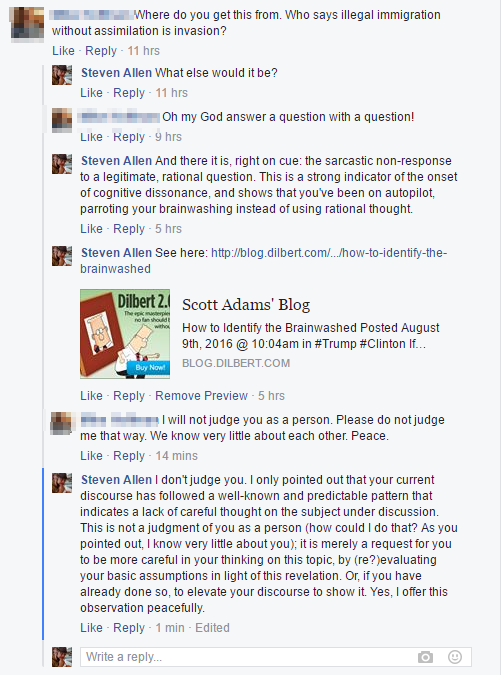
If you are not familiar with Scott Adams' How To Identify the Brainwashed , in which he goes over the "tells" that a brainwashed person will display when discussing a topic, you should be. One of the tells listed is "OMG", followed by either sarcasm or no argument at all. Well, in a debate last night, I saw this in action first-hand, and it was interesting to see exactly how accurate Mr. Adams' article was: Earlier in the debate (here is the  full debate , for reference), I had been using variations on Mr. Adams' techniques for How To Un-Hypnotize a Rabid Anti-Trumper , so it doesn't surprise me that I got a result he has encountered, but it was still thrilling to see it "in the wild". And of course, my interlocutor immediately took it as a personal insult that I would point this out to him, in spite of the fact that we are all brainwashed in one way or another. I guess I hit a nerve?

I'm Getting Too Old For This S***

The older I get, the less patience I have when it comes to theological discussions, at least online. I was recently reminded of this. For some odd reason, I was under the impression that a particular forum I'm part of online was a Christian group, and so I was participating in the various discussions with a basic understanding that we were all at least working from the same fundamental worldview. However, in one particular discussion, one of the moderators jumped into remind everyone (particularly me) that this was NOT a Christian group per se. Upon this revelation, I realized that I really don't care to participate in the group anymore. (This sort of surprised me as somewhat uncharacteristic of me.) I wrote up a private reply for the moderator, but I don't think I'm going to send it to him, considering that it might be a little "too much". Nevertheless, in the writing I gained a little insight into my newfound curmudgeonliness: [Redacted], I was unaw...

On icons vs. idols

Introduction Icons, images, idols. Do you know the difference? Many today do not know the differences among these three words, and so they either avoid such things, or fall into idolatry. Let me give a brief explanation of the history and meanings of these three words. WARNING : What you are about to read may alter the way you think in ways you cannot reverse and cannot ignore. If you'd rather just not know, close the page now. Proceed with caution. Images There is a whole long discussion that can be had over how the human mind is a pattern recognition engine, and how this allows for symbols to be. There is another whole long discussion about what symbols are in the first place. But I will skip both of those and simply say that an image is fundamentally a composition of components such that they form a recognizable pattern. An image is always an pattern evocative of some other pattern, whether assembled with intent (as in a building, or some such), or by "nature...

A Theory on the powers of the innocent first parents...

Theory: That Adam and Eve were not  created with the power to choose between  good and evil, but were granted this power subsequently, and that this power is not, therefore, part of our nature, but something added.  (Therefore, the resolution of this power, or its removal entirely, is not a violation of our nature.) Such a choice has as prerequisite the knowledge of the two, and since they were created innocent -- without that knowledge -- they did not therefore have the power to choose between them. ------- Option A: They were not even created with the power to choose the knowledge.  This was a gift of God, and the beginning of His tutelage of them as children, with an eye toward bringing them to full sonship.  He planted the garden, and placed them in it, and only then  did He cause the trees to grow, including "the tree of life also in the midst of the garden, and the tree of knowledge of good and evil".  And only then did He give the commandm...